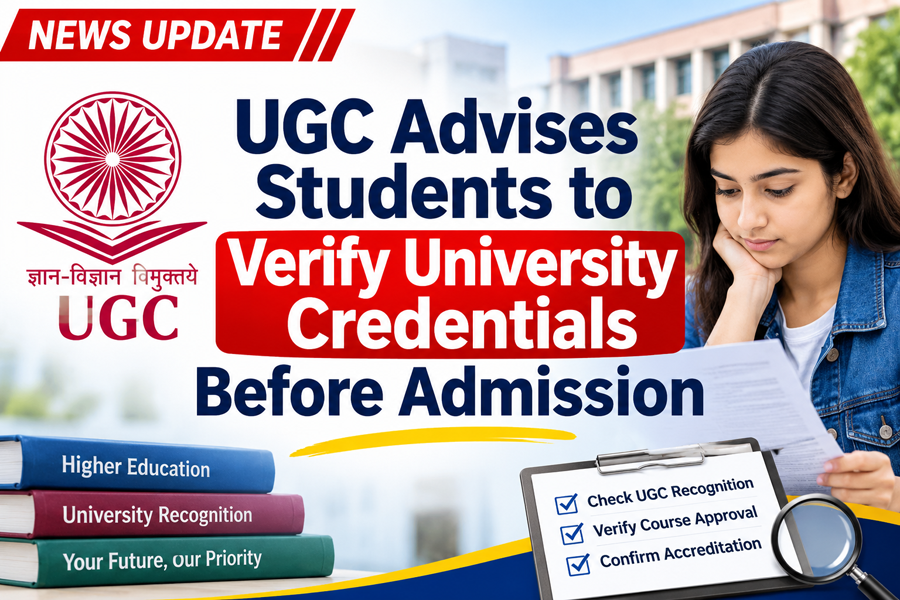
New Delhi: The University Grants Commission (UGC) has warned the students from depending on the advertisements, promotional activities and claims by the institutions themselves while selecting a university/college for higher studies.
The warning came amid worries over false advertisements, false claims regarding educational courses and placements, infrastructure, and recognition of the institution. As more and more universities and higher education institutions have started advertising their courses through digital means and advertisements, the students are being asked to be cautious while opting for admissions.
It is necessary for the students and their parents to ensure if the particular university is recognised legally and if the particular course which they want to join is approved or not.
Students urged to check recognition and approval status
As per the advisory, students must not take any decision of admitting themselves into an institute only based on good marketing material, star power or claims of placements and scholarships.
The message conveyed by the commission is of utmost importance for students who wish to take admission into private universities, online universities, distance learning programs, professional courses, and specialisation courses.
It must be checked whether the university is UGC recognised and whether the course can be run in that particular mode of study. In addition, approval or accreditation for the technical, professional and specialized courses is also needed at times.
Growing concern over misleading admission advertisements
Recently, many educational institutions have adopted an aggressive mode of marketing to attract students to enroll in their courses. Advertisements of college amenities, international linkages, industry linkages, placement packs, scholarships, admission packs and such others have gained popularity through television, print media and other forms of electronic media.
Although advertisement plays a crucial role in enabling students to get acquainted with educational institutions and their programs, experts feel that advertisement is not the ultimate source of information.
Students are often motivated through images of the campuses, promise of full placement assistance, lucrative salary packages, linkages with universities abroad and admission packs for certain periods. In reality, however, the quality of education, validity of degree, recognition of programs and job prospects are different from what is promised through advertisements.
UGC's advisory acts as a wake-up call for students to do their homework before depositing any money.
How students can verify a university before admission
Students and parents need to carry out the following due diligence before joining any university:
- Utility of UGC recognition: Confirm if the university has been recognised by UGC as a recognised university through its official website.
- Vouch for the course: See if the specific course is approved wherever required.
- Check recognitions of online and distance education courses: The students joining an online or distance education course must confirm if the programme-specific recognition has been given for the academic session.
- Check accreditation and ranking claims: See if the claims of accreditation like NAAC accreditation and rankings and other credentials of institutions are true through proper sources.
- Check placement claims: Students must ask for placement records, median salaries, recruiter details, and placement statistics, not just through advertisements.
- Know the fee structure: Check tuition fees, exam fees, hostel fees, extra charges, refund policy, and scholarship details.
- Check the degree awarding authority: It is necessary to know which institution will give the degree and if the degree is valid for work or study purpose.
Parents also need to exercise caution
The advice is also applicable to parents since they often have an important say in the choice and funding of higher education.
Education is one of the largest financial expenditures undertaken by the family. Incorrect admissions could cause financial damage, academic wastage, and problems with higher education and job search.
Parents need to convince the students to look at several institutions, tour their campuses if possible, talk to students and alumni, and carefully review the documents prior to paying any money.
Admission agents who pressure the students through claims such as limited seat availability, imminent expiration of the scholarship, or immediate deposit of the money should be approached with care.
Importance of informed admission decisions
Selecting a university for studies is a major choice which has a lot to do with shaping one’s future educational path and career options. In the light of growing competition in the higher education sphere, today’s students have to be ready to think beyond marketing strategies and choose universities in terms of their reliability, academic standards, transparency and legal compliance.
The message from UGC once again proves the significance of making a conscious decision regarding the choice of a higher education institution. One should keep in mind that an excellent advertising campaign doesn’t necessarily mean a recognized diploma, good education and bright career perspectives.