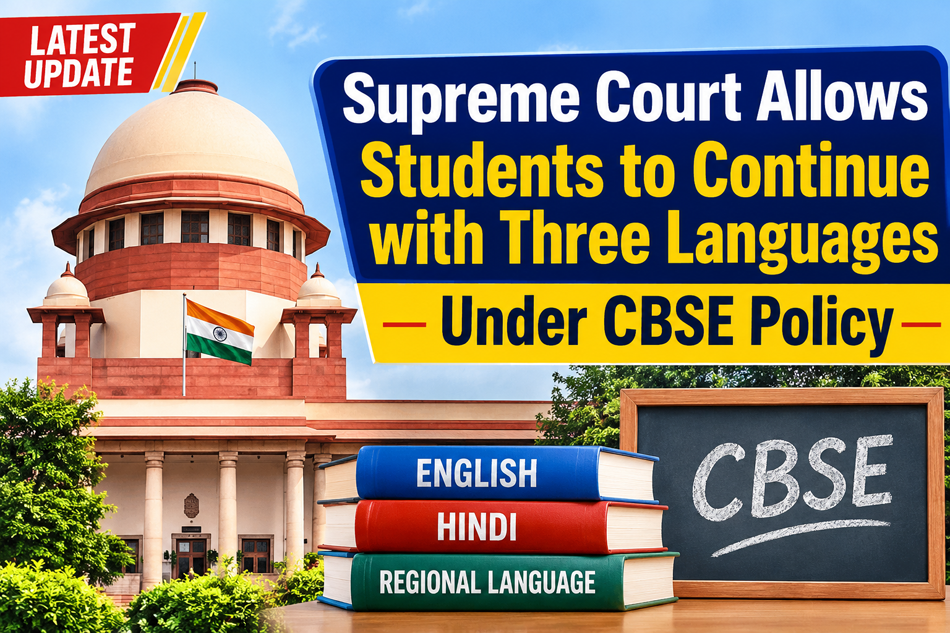
New Delhi: The Supreme Court of India has made a crucial clarification regarding the Central Board of Secondary Education (CBSE) three-language formula in which the students having chosen three languages will continue with the study of the same and shall not be forced to revert to the previous two-language formula.
The clarification was provided by the court on November 25, 2026, while hearing cases challenging the CBSE’s three-language formula, where the bench headed by Chief Justice of India Surya Kant and justices Joymalya Bagchi and V. Mohana.
Furthermore, students studying two languages during the period of transitional relaxation shall be allowed to continue with the same without being forced to change it midway during the session.
Supreme Court Seeks to Avoid Mid-Session Changes
This clarification followed after CBSE made an approach to the Supreme Court for modification of its September 28 order on the issue of the three-language policy. CBSE had expressed some concern about those students who had already chosen three languages prior to granting the temporary relaxation.
In the course of the hearing, Justice Joymalya Bagchi said that those students who had already chosen three languages should continue with the same, while others who had not chosen the third language should not be forced to choose any now.
The Chief Justice Surya Kant also made clear that students who had already chosen three languages should continue with the same.
The court made it clear that it was important not to disrupt the academic arrangements of the students.
What Does the Clarification Mean for Students?
This clarification from the Supreme Court offers continuity to students enrolled in CBSE affiliated schools, especially those in Grades 6 to 9 who fall under the transitional provisions.
Some of the main implications of this clarification include:
• Students who chose three languages: These students can continue studying all three languages.
• Students studying two languages: Students who are studying two languages will be allowed to continue under the provisions of transitional relaxation.
• No change in language subjects: No compulsion to change the language subjects by any schools during the academic year.
• Assessment of the third language: Third language of those students who are under transitional provision will be assessed internally and not through CBSE Board Examination.
This clarification from the Supreme Court ensures that no student faces any problems due to changes in the policy.
Background: CBSE's Three-Language Policy
Three-Language Formula has been devised by CBSE in accordance with NEP 2020 and NCF-SE 2023.
The three-language formula envisages that three languages must be taught to the students wherein at least two would be Indian languages. Such a policy intends to promote multilingualism among the students.
Implementation of such policy is however legally challenged by the parents and other stakeholders on account of the practical problems arising from implementation of the same, shortage of teachers of those languages, and additional academic load on students.
The Supreme Court had previously raised questions as to whether English is not an Indian language and asked CBSE and other relevant authorities about their preparedness to implement the formula.
The court has also stressed upon the aspect of avoiding undue pressure on students during the implementation of such a policy.
Relief for Students, Parents and Schools
This latest clarification will hopefully shed light on the continued practice of language choice by the CBSE-affiliated schools, parents, and students.
By enabling students that had opted for three languages to maintain their choices and safeguarding those falling under the two-language exemption category, the Supreme Court has tried to avoid making any unwarranted changes during the ongoing academic year.
This issue is especially relevant for schools in the context of their academic planning for the year 2026-27.
The entire issue will retain its significance in the larger debate about the adoption of the three-language formula in the Indian schools.