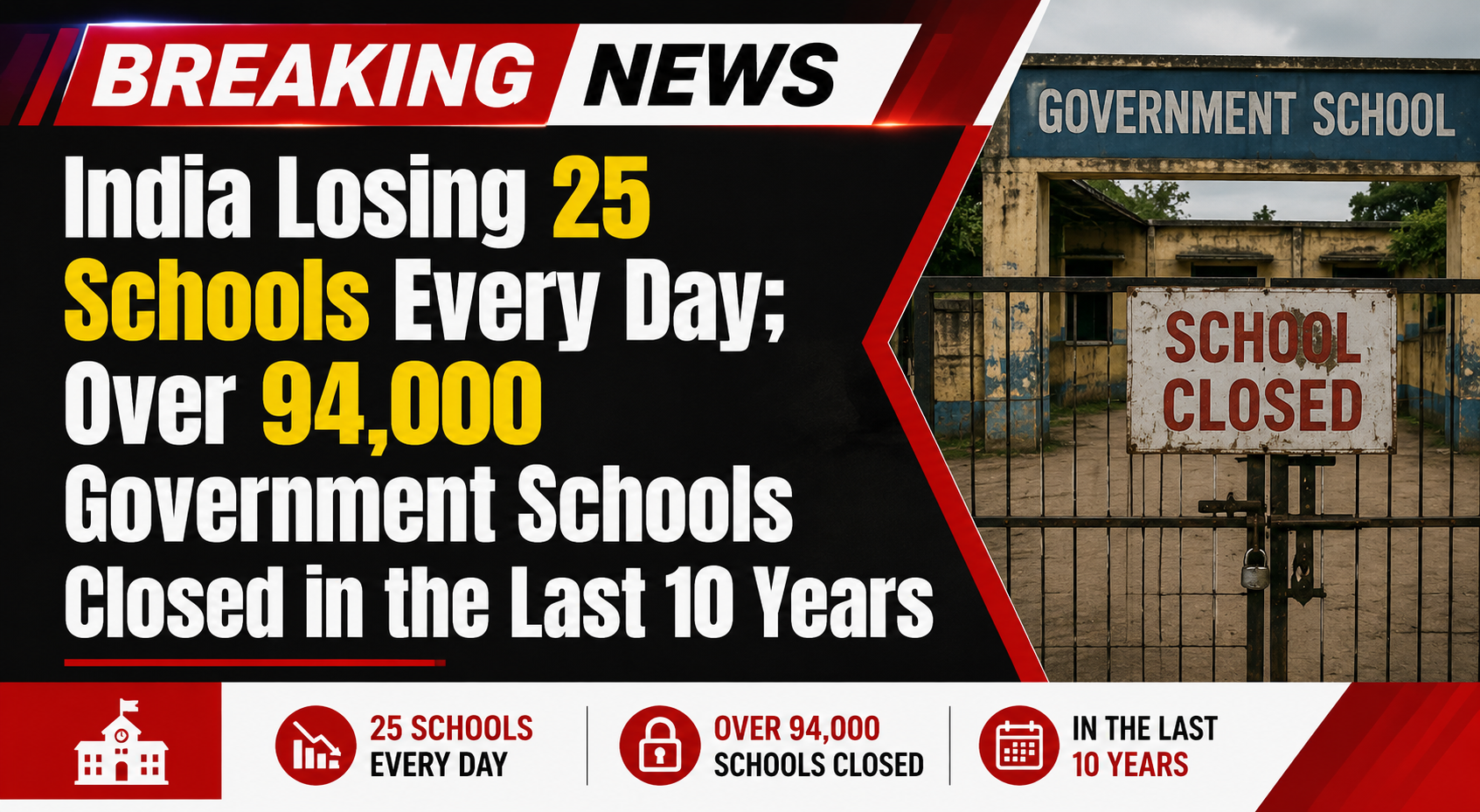
Recent reports indicate that the education system in India is witnessing a fundamental shift. NITI Aayog has released a policy paper called "School Education System in India: Temporal Analysis and Policy Roadmap for Quality Enhancement." According to the paper, in the past ten years, at least 94,000 government schools have shut down across the country, averaging about 25 schools every day.
The report states that school amalgamations, rationalizations, changing demographics, as well as declining enrollment rates have contributed to the problem. The report also makes use of data obtained from the UDISE+ analysis along with other national educational statistics between the period of 2014-15 to 2024-25.
Why Are Government Schools Closing?
The report from NITI Aayog identifies the following as the major causes: Drop in the number of students enrolled.
- Changes in demographics and reduction in birth rates.
- Families migrating from rural to urban areas.
- Rationalization of schools by state governments and consolidation of institutions.
- Improved use of resources through cooperation between schools with low enrollment.
Impact on Students
Although the combination of schools can lead to improved facilities and distribution of resources, specialists in the field of education have pointed out that this could also mean increasing the distance students have to travel, especially in distant areas such as rural and tribal regions. Such an outcome may lead to low attendance and a higher drop-out rate among children of disadvantaged families.
A Growing Shift Towards Private Schools
Moreover, data has indicated some changes in parental needs now. For example, over the last ten years, number of private school students has steadily gone up while the figure for public schools has declined. Although scientists still stress the importance of higher quality of public education for equal access to education, the results of the research demonstrate the modifications in parental desires, urbanization as well as in the potential for other educational alternatives available to parents nowadays.
Policy Recommendations
NITI Aayog has proposed measures to enhance learning outcomes, give a boost to the quality of teaching, improve the educational infrastructure, promote digital learning and ensure that school amalgamation does not deny access for children to education, regardless of their remote location. The document states that the accessibility of education must be balanced with its quality.