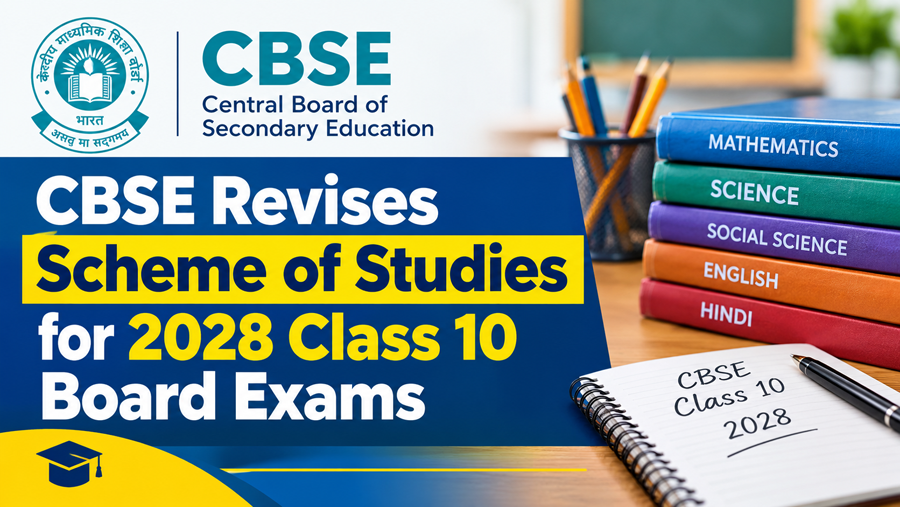
New CBSE curriculum framework sees changes in language choice for secondary level classes. Students appearing for CBSE Class 10 Board Exams 2028 would require knowledge of the new Scheme of Studies, which includes R1 and R2 languages and the provision of third optional language.
Central Board of Secondary Education (CBSE) has made certain changes in its Scheme of Studies due to the implementation of NCF-SE 2023. The new scheme of studies provides a new approach towards language teaching at Class IX and X level by introducing changes in language choice, textbooks availability and continuation of subjects in these two classes.
These modifications will be of particular importance to those students appearing for CBSE Class 10 Board Examination in 2028, who would be studying in Class IX during the 2026-27 academic session and then Class X in the 2027-28 academic session. Thus, the selection of languages in Class IX would play an important part in deciding their academic schedule in Class X.
The CBSE has also provided clarifications on the implementation of the new language scheme, highlighting provisions related to R1, R2, and R3 languages.
CBSE Three-Language Formula: What Changes for Class 10 Students in 2028?
The next major change is the introduction of the three-language formula (R1, R2, and R3) for Classes IX and X. In its CBSE Circular No. Acad-33/2026 dated May 15, 2026, the Board made the study of three languages mandatory for Class IX from July 1, 2026, as per the revised curriculum framework.
As per this new rule,
• The students should study three languages: R1, R2, and R3.
• At least two out of the three languages should be native Indian languages.
• The foreign language may be studied as the third language, but then the other two languages should be the native Indian languages.
• The foreign language may be taught as a fourth additional language too.
• The schools will have to arrange the language course as per the CBSE approved syllabus and language options.
The three-language system is aimed at fostering multilingualism and developing effective communication skills of the students.
What Are R1, R2 and R3 Languages?
Under the revised CBSE language framework, R1, R2 and R3 represent three levels of language learning.
| Language level | Meaning |
| R1 | First language |
| R2 | Second language |
| R3 | Third language |
The students will be taught in all the three languages, and their purpose is to develop the abilities of reading, writing, speaking, and understanding.
Further, the Board has explained that there will be no external board exam of the CBSE Class 10 for the R3 language, and it will be internally assessed at school level. However, completing the third language is a must for obtaining Class 10 certificate.
At Least Two Indian Languages Will Be Required
Yet another important aspect of the CBSE Revised Scheme of Studies 2028 is the promotion of Indian languages.
The students are required to study at least two Indian languages out of their three languages. It implies that students who wish to pursue a foreign language like French or German or any other international language have to see to it that their two other languages fall within the category of Indian languages.
The programme has been designed in accordance with the NEP 2020 and NCF-SE 2023 as both these policies advocate multilingualism as well as learning of Indian languages.
CBSE is aware of the difficulties faced by schools in hiring competent teachers for teaching some of the regional languages. To address this concern, the Board has provided some transitional measures including teacher-sharing amongst schools, virtual/hybrid teaching assistance, and hiring suitably experienced retired teachers/postgraduates.
Important Changes in R3 Assessment for the 2028 Board Batch
For those taking the CBSE Class 10 Board Examination 2028, it is important to note certain aspects of the third language assessment procedure.
There will be no separate external CBSE board exam in the third language. Schools will assess the performance of the candidates in R3 through internal assessments.
This new system is meant to relieve students from examination stress while making sure that all three languages are studied by the candidates.
Nonetheless, candidates cannot consider that the lack of a separate board examination implies that the third language is optional. The new implementation process makes it mandatory to clear the third language requirement in order to get the CBSE Secondary School Examination Pass Certificate.
In case a candidate fails the R3 assessment, he/she has to be provided with an opportunity to retake the test according to the guidelines of CBSE.
This is the important information for both parents and students taking the CBSE Class 10 exams in 2028: the third language is not a separate board exam but it is a significant academic requirement.
R1 and R2 Board Examination Papers to Have Different Assessment Patterns
The other notable change has to do with the evaluation of R1 and R2 language courses.
According to the Revised Scheme of Studies, there would be separate learning outcomes, syllabi and assessment criteria for R1 and R2 levels. Even if students opt to study from the same textbook at both levels, there would be differences in academic standards and mode of evaluation.
The revised document outlines the need for separate assessment schemes for R1 and R2 languages in the Class 10 Board Examination, starting with the examinations in 2028.
The implication here is that schools and students will have to be mindful about the level of language opted during admissions and course selection. It does not always imply that students who study from the same book will have the same examination needs.
English Communicative Course Discontinued for New Class IX Students
Changes are also made to English studies due to CBSE language reform.
CBSE discontinues the old English Communicative course for Class IX for students starting Class IX in 2026-27 academic year. A single English course will be there with the new curriculum.
A new NCERT English book called "Kaveri" is made compulsory for Class IX students and can be studied on R1 and R2 levels depending on learning outcomes and assessments.
But students that were following the old English Communicative course in Class IX in the old academic year but then moved to Class X in 2026-27 are allowed to follow the old course only.
It is necessary to note this difference because students can get confused between the new English course for new Class IX students and the arrangement of old Class X students.
New NCERT Textbooks and Regional Language Learning
In addition to implementing the R3 syllabus, NCERT and CBSE have undertaken efforts to provide appropriate textbooks for various Indian languages.
In terms of transitional implementation of R3 syllabus, Class VI-level R3 textbooks would be used for Class IX students in the year 2026–27 with additional literary material from local/state level, like short stories, poems, and non-fiction.
The Board has recommended 19 Scheduled languages for R3 textbook preparation, which include the following languages:
• Assamese
• Bengali
• Bodo
• Dogri
• Gujarati
• Kannada
• Kashmiri
• Konkani
• Maithili
• Malayalam
• Manipuri
• Marathi
• Nepali
• Odia
• Punjabi
• Santhali
• Sindhi
• Tamil
• Telugu
For other Indian languages, suitable SCERT textbooks can be adopted.
What Should Schools Do to Implement the Revised CBSE Curriculum?
Appropriate academic and administrative arrangements would have to be made in the light of this Scheme of Studies.
For CBSE affiliated schools, it would be necessary to review the languages currently being offered by them, find appropriate teachers for these languages, obtain the required texts and ensure that there is proper understanding regarding the subject structure.
Orientation programs for both parents and students might also become necessary so that the selection of languages is done after properly comprehending the R1, R2 and R3.
The Board has acknowledged that there might be a shortage of language teachers for certain Indian languages. It has been advised that schools can try collaboration methods like sharing teachers from Sahodaya school clusters, virtual teaching and hiring retired teachers.
All these steps have been taken by the Board so that implementation of the new curriculum does not disrupt classroom teaching.
How Will the New Scheme of Studies Affect Students?
The New CBSE Scheme of Studies is a significant step forward in the academic setup of secondary education.
The CBSE Scheme of Studies in relation to three languages makes language studies more important for the students taking the Class 10 Board Examination 2028.
Students would have to juggle their subjects along with language study. Parents must also make a discussion of language with schools prior to deciding upon the subjects.
However, the internal assessment of R3 gives an option other than another board examination. It is aimed at learning all through the year rather than making the subject dependent upon a single board exam.
In addition, it is also one of the purposes of NEP 2020, which is to bring about a school education system that promotes multilingualism, concepts, learning, and overall development of students.
CBSE Class 10 Board Exams 2028: What Students and Parents Should Remember
The modified CBSE Scheme of Studies is expected to affect academic planning in schools to a great extent. The students who are joining Class IX in the 2026-27 academic session should know about the three-language approach and the differences between R1, R2 and R3.
The parents are requested to get in touch with their respective schools to find out the languages being taught, the books being used and the internal assessments required.
In schools, it becomes imperative that teachers are well-prepared for this change and the students are guided about this academic structure.
This comes under the initiative of CBSE to implement NEP 2020 and NCF-SE 2023 with more importance on multilingual and holistic education.
For the latest and most accurate information regarding the three language approach, it is advised to visit the official CBSE website and not go by unofficial sources, which could be giving misinformation.
For CBSE Board Exam 2028 updates, new syllabus, exam pattern, NCERT books, sample papers and educational news, visit Educationkhoj.com.