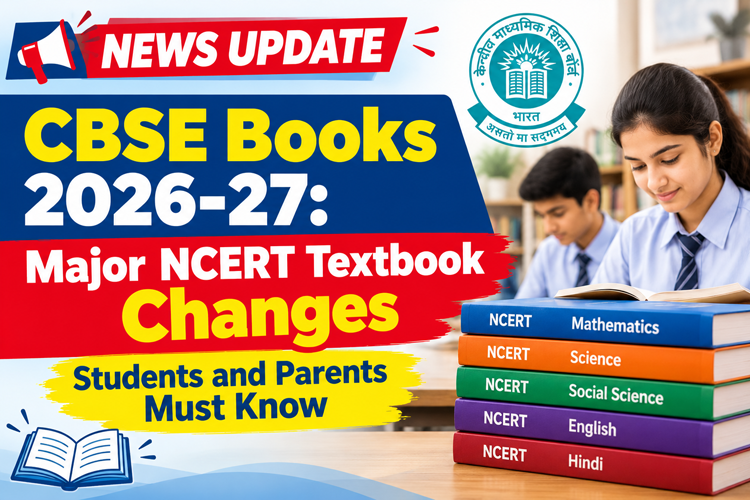
CBSE Books 2026-27: There have been several changes in school textbooks used by CBSE schools, as NCERT has been implementing its new curriculum policy with respect to NEP 2020 and NCF-SE 2023.
It should be noted that even though these changes are often called “CBSE book changes”, the truth is that NCERT designs the books, while CBSE prescribes them for specific classes and subjects. NCERT books have been made mandatory by CBSE for Classes IX to XII in subjects in which the NCERT books have been prescribed.
The changes in the curriculum are not just addition and/or deletion of certain chapters. Rather, the curriculum stresses the importance of competency-based learning, conceptual learning, experiential learning, Indian knowledge systems, cross-curricular links, values and inclusion and technology-enabled education.
New NCERT Books Being Introduced in Phases
NCERT has been systematically substituting its old books with new ones. The Class 9 NCERT Maths, Science, and Social Science books for the year 2026-27 are some of the recent developments in this regard. New NCERT books for various classes such as Class 1 to Class 9 have already been brought out.
The NCERT Class 9 books have been designed on the basis of competencies and learning outcomes instead of traditional chapters based organization of content. The new curriculum emphasizes activity-based learning and applications.
On the other hand, NCERT books for Classes 10 to 12 are under process of revision and are expected to be available soon.
Class 9 Mathematics Gets a New Approach
One of the key changes introduced is the development of the new Mathematics textbook of Class 9, Ganita Prakash.
The new curriculum for Mathematics is centered around concept and application of the concepts of mathematics rather than being focused on just knowing the formulae and solving the mathematical problems.
A lot of debate went on regarding whether or not any of the topics had been eliminated from the Class 9 Mathematics syllabus. NCERT, in response to this debate, issued a clarification statement in September 2026 where it mentioned that no topics were eliminated from the draft syllabus but some of the topics, which had been covered as units earlier, have been included in the chapters of the draft.
Science and Social Science Also Revised
Class 9 Science and Social Science have also undergone restructuring under the new curriculum structure.
The new Social Science book titled Understanding Society: India and Beyond is being launched in two parts. While the first part came out in advance, the second one is out in September 2026.
The new Social Science curriculum integrates elements from history, geography, political science, and economics into a holistic structure and also introduces current issues along with an Indian perspective.
Indian Knowledge Systems and cultural practices are also highlighted through the new textbooks.
‘Ram Rajya’, Rajdharma and Sengol
A recently released book on social science for class 9th contains a chapter on “Governance and Public Policy.”
This chapter introduces concepts like Rajdharma and Ram Rajya where even the interpretation of Ram Rajya by Mahatma Gandhi is mentioned in relation to governance. Sengol and other examples of governance in Indian history have been discussed.
Then there is a shift towards modern forms of governance and institutions of governance and public policies, which include modern efforts and NEP 2020.
This is an approach in which students need to understand governance in relation to historical, constitutional and modern times.
Medieval Indian History Has Been Reframed
A second major shift is evident in the portrayal of medieval Indian history.
The revised version of Class 9 Social Science textbook portrays the time period between 1000 to 1700 CE on the basis of the concept of “Resistance and Resilience” where much importance has been laid on the response of Indian society to external factors.
This portrayal is different from previous textbooks in terms of structure and content. This shift has led to discussions among historians and educators regarding the portrayal of medieval Indian history.
Class 8 Social Science Book Revised
A significant change to a textbook occurred in Class 8 Social Science in 2026.
The previous edition contained a chapter that talked about “corruption in the judiciary” and the pendency of cases in the judiciary. This was after the Supreme Court’s intervention; the old edition was taken down, and NCERT issued a new one.
The new version of the chapter dealing with the judiciary is without those controversial sections and instead covers issues such as:
• Public Interest Litigation (PIL)
• Tribunals
• Alternative Dispute Resolution
• Constitutional functions of the judiciary
• Judicial procedures and remedies
Among other changes made in the new version of the textbook is one that relates to the discussion of discrimination where economic context is also considered along with caste, religion, ethnicity, disability, race, physical appearance, gender, and sexuality.
Changes were also reported relating to mentioning Hitler and Nazism and the Congress stance on Partition.
More Focus on Competency-Based Learning
Possibly one of the most significant things that have been changed in these NCERT books is not a specific historical aspect but how the students are supposed to learn.
NCF-SE 2023 highlights the following key aspects of learning:
• Conceptual learning
• Critical thinking
• Creativity
• Experiential learning
• Application of knowledge
• Cross-curriculum learning
• Values and dispositions
• Inclusion
• Indian Knowledge Systems
• Educational technology
• Holistic assessment
According to the advisory of NCERT to the schools, it is important for students to understand the concepts and think critically and creatively while learning.
It implies that the textbooks are aimed at making the students move from memorization to conceptual and applicative learning.
Changes in the Way CBSE Schools Use Books
CBSE has also made modifications in its norms in relation to textbooks in 2024. In classes IX-XII, the schools should use prescribed NCERT textbooks if these are available. However, in case NCERT/SCERT textbooks are not available for any subject, then the CBSE textbooks uploaded by the Board in its website have to be used.
Supplementary material can be used by the school; however, the material used must be in line with the NCF-SE.
This is important because there would be a distinction created between the prescribed textbook and the material used for learning purposes.
What About Classes 10, 11 and 12?
Students enrolled in Classes 10 through 12 should not presume that all classes have been provided with a brand new book for the academic year 2026-27.
As was made clear by NCERT in 2026, new books for Classes 10 and 11 would not be issued for the present academic year but would only be introduced from the 2027-28 academic year. On the other hand, the process of revising senior-secondary textbooks is ongoing.
Hence, there is a gradual shift towards new textbooks instead of an instant shift.
What Students and Parents Should Know
The alterations made in NCERT textbooks constitute part of an overall restructuring in school education, beyond the mere alterations in chapter content.
For the students, the new textbooks imply a focus on more comprehensions, applications, activities, interdisciplinary learning, and competence-based assessments. In addition, some subjects also have significant alterations in historical, political, and contemporary context when compared to earlier versions of the same.
It is imperative, therefore, that students are using the most recent edition of NCERT textbooks as recommended by CBSE for each class and subject, and not old textbooks or even unauthentic PDF versions.
The transition from one textbook to another is likely to continue in the upcoming academic sessions in a move towards the implementation of NEP 2020 and NCF-SE 2023 in school education.