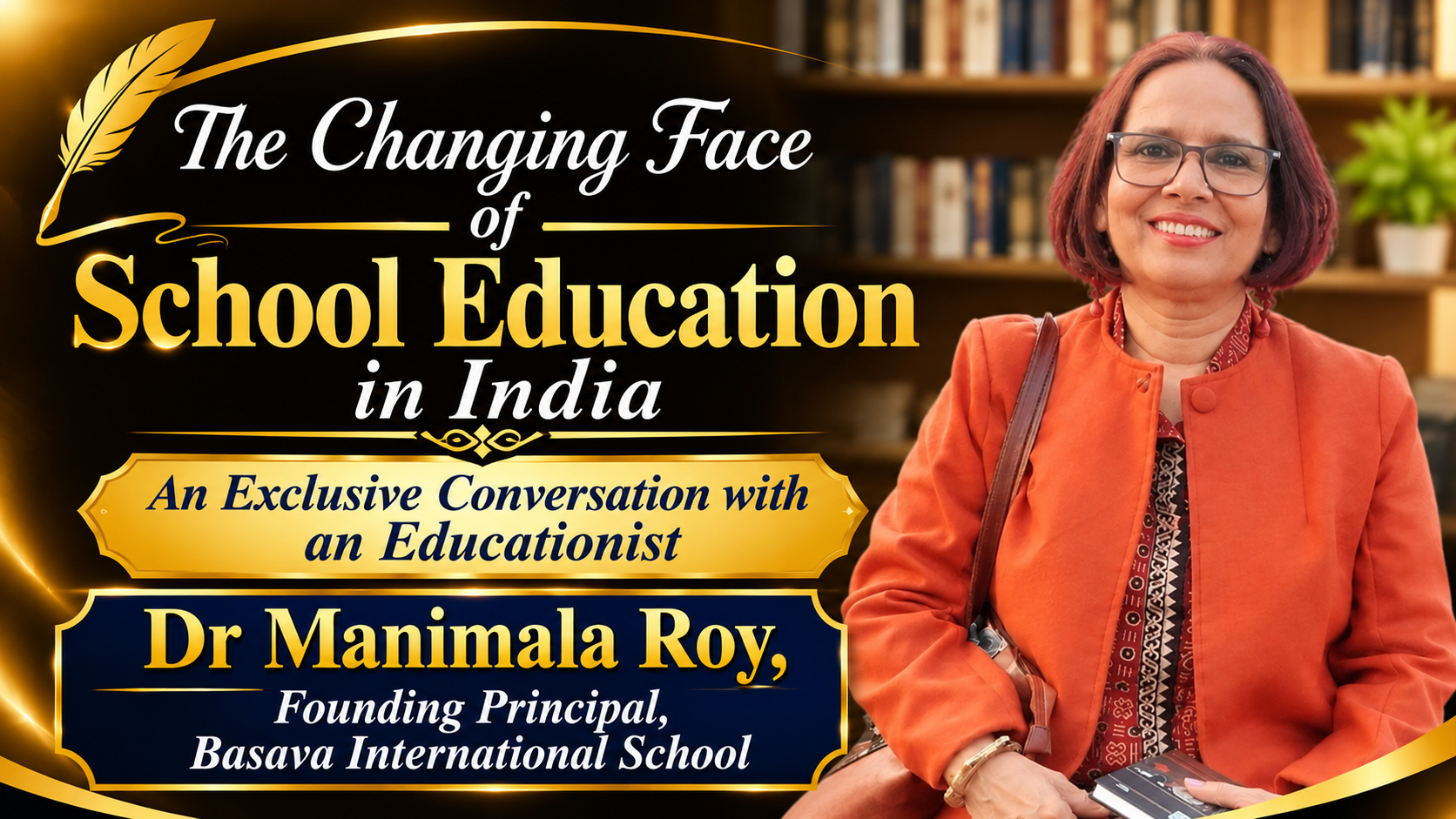
An Exclusive Conversation with an Educationist on the The Changing Face of School Education in India.
1. Having served as a school principal how would you describe the transformation of school education in India over the past two to three decades? What are the most significant changes you have witnessed?
Changes in two decades have been quite significant. From lecture method the emphasis has moved on to experiential and hands-on activities. The approach to education and its purpose have changed. Instead of good marks and high academic scores school education has started focussing on overall and holistic growth of a child. Emotional and social skills have been acknowledged and encouraged. A thrust on team spirit and collaborative learning is found in all schools these days.
2. The National Education Policy (NEP) 2020 aims to make education more holistic, flexible, and skill-oriented. How effectively do you think schools are implementing its recommendations?
Implementation of an excellent policy is at the core of its success. In order to implement NEP 2020 to its spirit we need extensive training and orientation of the teaching faculty. The schools that have taken care of in-service teachers’ training, workshop and skill formation initiatives are better placed to carry forward the vignettes of NEP 2020. Motivating teachers to understand the policy’s inner benefits for our children’s future and their own role as the spark to ignite that intellectual stimulation will go a long way.
3. Traditional classroom teaching is increasingly giving way to experiential, activity-based, and student-centred learning. Do you believe this shift is improving students' understanding and academic performance?
Definitely the change is timely and enhancing children’s understanding and problem-solving capacities. In this Anthropocene era when the survival of the planet depends on human actions, it is important that the students experience the world around them through activities like field work, research, physical exploration, scientific experiments and interactions with people around them. I would like to mention the construction of life size dioramas by the students of my school on how marine life is getting destroyed by human callousness where they, and the faculty and parents, as well as the visitors, learned why the coral reefs are bleaching fast and how big sea animals are trapped in trash thrown into the sea by careless maritime tourists. The construction of the diorama which involved converting a room into a pretend sea bed also taught the students team spirit, art, reuse of discarded materials and stimulated their thirst for knowledge and improved their skills to analyse and synthesise that knowledge.
4. Technology, artificial intelligence, and digital learning tools are changing the way students learn. How can schools use these technologies effectively without making students overly dependent on screens?
It is important to balance screen time and real time experiences of the students in school. Today when artificial intelligence has progressed at an overwhelming pace and human life has already experienced its omnipresence we have to remember as caregivers to our children that human brain is much more potent than AI. They should be able to lead the AI and get things done by technology, not the other way round. This requires expanded knowledge base, foresight and scientific and analytical mindset for all in the school community. For example, use of Chat GPT is common these days but it is to understand that only when good inputs are given to the App good output can be obtained which requires broad knowledge base on the part of the user. Similarly, Immersive technologies to be adopted for better virtual learning experiences of the students keeping in mind their pros and cons. Schools should also keep physical exercises, dance and music and art education as integral part of the curriculum to balance out the negative impacts of screen time on students’ health and mind. Social skill development is essential to ward off the isolation syndrome that students develop when too much time is spent with gadgets.
5. In today's competitive environment, schools often focus heavily on marks, board examination results, and rankings. How can schools strike a balance between academic excellence and the overall development of students?
Academic excellence cannot be measured by the marks scored in an exam. The basic outcome of learning should be assessed by the understanding and application of the concepts in real life. In order to guide students towards that schools need a holistic child-centric and futuristic approach. I do not believe in competition. To excel, one has to develop his/her innate qualities and know and acknowledge one’s own limitations. Today when we literally live in a global village and technology is overwhelmingly present in our lives destroying all barriers of privacy, children need to learn team spirit and understand that we can go forward only when we move together. This is true for the schools as well. The more collaboration, the more will be learning achievements for all. I have noticed that students who are all rounders normally excel in academics too. Proper curriculum planning integrating all other activities with scholastic programmes is an essential task for the school.
6. Mental health, stress, anxiety, and peer pressure have become important concerns among school students. What measures should schools take to create a supportive and emotionally healthy learning environment?
Mental health issues in children have gone up world over but we do not yet give proper attention to it. According to a report by the WHO in 2024, ‘an estimated 1 in 7 children and adolescents aged 10 to 19 are affected by mental health conditions, with anxiety, depression, and behavioural disorders among the most common’. It requires immediate attention on the part of the caregivers to know the early signs of depression in children and seek interventions from experts. School counsellors should conduct regular orientation workshops for parents and teachers to make them aware of how to look for the signs. Regular stress management and life-skill workshops for children are necessary. School can tie up with external agencies well equipped in this field. In most of the cases children do not find a supportive adult who will listen to them without judgement. That makes them withdraw in themselves and the stress gradually piles up to give rise to anxiety and depression. Physical exercise, yoga, art, music and dance are effective instruments for stress release.
Dr. Manimala Roy
Founding Principal, Basava International School
Author of “From Shanties to School: A Silent Movement”