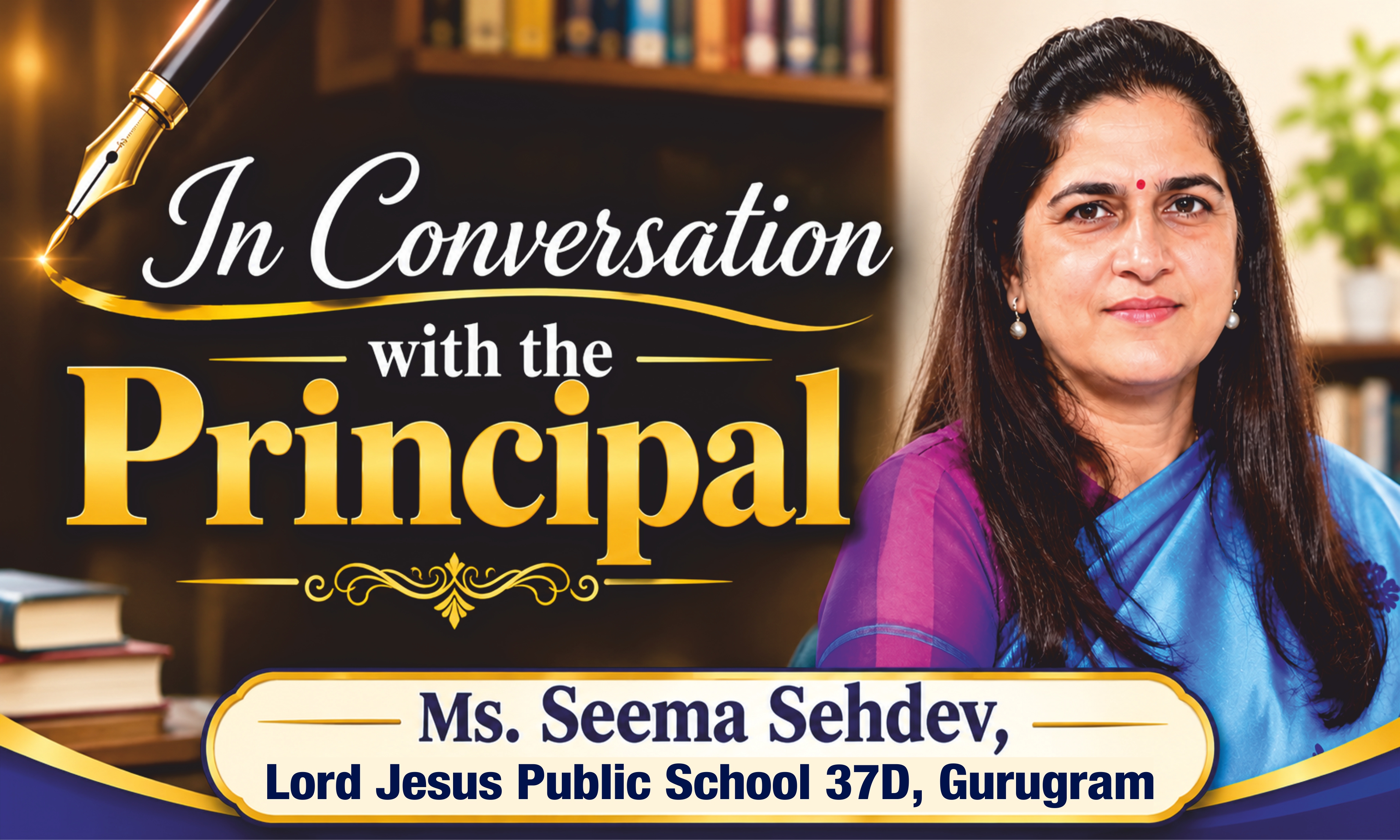
In Conversation with the Principal: Insights, Experiences & Perspectives on the Changing Face of Education
1. Please introduce yourself and share your journey in the field of education.
I am Seema Sehdev, an educationist and school leader with a deep commitment to nurturing young minds and preparing students for life. My journey in education has been guided by the belief that education is not merely about academic achievement; it is about developing confident, responsible, compassionate, and capable individuals.
As a Principal, I consider it my responsibility to create an environment where students feel encouraged to explore, question, learn, and grow. Over the years, I have come to appreciate that every child has unique potential, and the role of an educator is to identify that potential and provide the right opportunities for it to flourish.
My educational philosophy is rooted in the idea that schools must prepare students not only for examinations but also for the challenges and opportunities of the real world.
2. Could you tell us about your school's vision, mission, and the values it aims to instill in students?
At Lord Jesus Public School 37D, our vision is to nurture individuals who are academically competent, emotionally balanced, socially responsible, and equipped to contribute positively to society.
Our mission is to provide meaningful learning experiences that promote intellectual curiosity, character development, creativity, and lifelong learning.
We aim to instill values such as integrity, respect, empathy, discipline, responsibility, and perseverance. We believe that these values, when practised consistently, help students become not only successful learners but also thoughtful human beings.
3. What makes your school unique, and how does it stand apart from other institutions?
What makes our school special is our belief that every child matters. We strive to create a learning environment where academic expectations go hand in hand with personal growth and individual attention.
We recognize that students learn differently and develop at different paces. Therefore, we encourage teachers to understand individual learning needs and provide opportunities for students to discover their strengths.
Our focus is on helping students become independent thinkers, responsible decision-makers, and confident individuals who are prepared to face life's challenges.
4. What are the key initiatives your school has introduced in the past few years to enhance student learning and overall development?
We have been working towards making learning more engaging, meaningful, and connected to real-life experiences.
Our emphasis includes experiential learning, activity-based teaching, project work, collaborative learning, and opportunities for students to participate in assemblies, competitions, cultural activities, and leadership responsibilities.
We also encourage the integration of technology into teaching and learning and promote skill development alongside academic learning. Our objective is to help students understand concepts deeply, apply their knowledge, and develop confidence in their abilities.
5. How do you ensure a healthy balance between academic excellence and extracurricular activities?
We believe academics and extracurricular activities complement each other. Academic learning develops knowledge and intellectual discipline, while extracurricular activities nurture creativity, teamwork, confidence, communication, and resilience.
We plan school activities in a way that allows students to participate meaningfully without compromising their academic responsibilities.
Our aim is not simply to keep students busy but to ensure that every activity contributes to their overall development. A well-rounded education enables children to discover interests and abilities that may not always emerge through classroom learning alone.
6. In today's rapidly changing world, what skills do you believe students must develop to succeed in the future?
Students today need much more than subject knowledge. They must develop critical thinking, creativity, communication, collaboration, adaptability, digital literacy, and problem-solving skills.
Equally important are life skills such as emotional regulation, time management, decision-making, resilience, and self-awareness.
The future belongs to individuals who can continue learning, respond constructively to change, and apply their knowledge to unfamiliar situations. Schools must therefore focus on developing the ability to learn, unlearn, and relearn.
7. How has technology transformed teaching and learning in your school?
Technology has expanded the possibilities of teaching and learning by making information more accessible and lessons more interactive.
Digital resources, multimedia presentations, and educational platforms can help teachers explain complex concepts, accommodate different learning styles, and encourage student participation.
However, we believe technology should enhance the teacher's role, not replace it. The effectiveness of technology depends on how thoughtfully it is integrated into the learning process.
We also recognize the importance of teaching students responsible digital behaviour, online safety, and the ability to evaluate information critically.
8. What role does Artificial Intelligence (AI) play in education, and how is your institution preparing students for an AI-driven future?
Artificial Intelligence is transforming the way we access information, solve problems, and perform tasks. In education, it offers opportunities for personalized learning, immediate feedback, and support for teachers in planning and creating learning resources.
At the same time, students must understand that AI-generated information is not always accurate and that technology cannot replace human judgement, empathy, or ethical responsibility.
We believe students should develop AI literacy, learn to use emerging technologies responsibly, and understand the importance of originality, critical thinking, and academic integrity. Preparing students for an AI-driven future means helping them become thoughtful users and creators of technology rather than passive consumers.
9. Mental health and emotional well-being have become increasingly important. What initiatives has your school taken in this area?
A child's emotional well-being is closely connected to learning, behaviour, and confidence. We believe students learn best when they feel safe, respected, and supported.
We encourage open communication between students and teachers and emphasize the importance of understanding the reasons behind a child's behaviour rather than reacting only to the behaviour itself.
We also recognize the importance of collaboration between schools and parents. By maintaining communication, identifying concerns early, and providing appropriate guidance, we can help students develop emotional resilience and a healthy sense of self-worth.
10. How do you encourage creativity, innovation, critical thinking, and problem-solving among students?
We encourage students to ask questions, explore different perspectives, and approach problems with curiosity.
Classroom discussions, project-based learning, group activities, presentations, and real-life problem-solving tasks provide opportunities for students to think independently and creatively.
We also encourage teachers to create classrooms where students feel comfortable expressing ideas and making mistakes. Mistakes are an important part of learning when students are guided to reflect on them and improve.
11. What strategies do you use to ensure continuous professional development and motivation for your teaching staff?
Teachers are lifelong learners, and their professional growth directly influences the quality of education.
We encourage teachers to participate in professional development programmes, workshops, collaborative discussions, and reflective practices. Sharing classroom experiences and learning from colleagues can be as valuable as formal training.
As a school leader, I believe motivation grows when teachers feel respected, trusted, and supported. Recognizing their efforts, encouraging innovation, and providing opportunities for professional growth are essential to building a positive school culture.
12. What are the biggest challenges schools are facing today, and how can they be addressed effectively?
One of the biggest challenges is ensuring that education remains meaningful in a rapidly changing world while meeting academic expectations.
Schools must also address the impact of excessive screen use, changing student behaviour, emotional well-being concerns, and the diverse learning needs of children.
These challenges require a collaborative approach involving schools, families, and the wider community. We must move beyond purely examination-oriented learning and focus on developing skills, values, adaptability, and responsible citizenship.
13. How do you identify and nurture the individual talents and potential of every student?
Every child has strengths, interests, and abilities that may not always be reflected in academic performance.
We encourage teachers to observe students in different learning situations and provide opportunities to participate in academics, sports, arts, leadership, and other activities.
Through individual encouragement, constructive feedback, and opportunities to explore new interests, we help students recognize their potential and build confidence.
Examinations are important for assessing students' learning, but we must also focus on their talents, skills, confidence, and overall development.
14. What measures does your school take to promote values such as discipline, empathy, respect, environmental responsibility, and social awareness?
We believe values are best taught through everyday experiences and the example set by adults.
Through classroom interactions, assemblies, collaborative activities, school responsibilities, and discussions about real-life situations, we encourage students to practise respect, empathy, responsibility, and fairness.
Environmental awareness and social responsibility are also important aspects of education. We encourage students to understand how their everyday choices affect others and the world around them.
Our goal is to help students understand that discipline is not merely about following rules; it is about developing self-control, accountability, and respect for others.
15. If you could recommend one change in India's education system, what would it be and why?
I would recommend a stronger and more consistent focus on skill-based, experiential, and life-oriented education.
Academic knowledge is important, but students must also learn how to apply that knowledge, communicate effectively, solve problems, manage responsibilities, and work collaboratively.
Education should provide every child with opportunities to develop practical competencies alongside academic understanding. This would help bridge the gap between classroom learning and the demands of real life.
16. What advice would you give to young teachers who aspire to become successful educational leaders?
My advice to young teachers is to remain curious, compassionate, and committed to continuous learning.
Leadership in education begins with understanding people. A good educational leader listens, reflects, takes responsibility, and creates opportunities for others to grow.
Do not measure success only by academic results. Look at the confidence you build, the values you nurture, and the positive difference you make in the lives of students and colleagues.
Above all, remember that leadership is not about authority; it is about responsibility, trust, and service.
17. What message would you like to share with students who are preparing for their future careers?
Believe in your potential, but remember that success requires consistent effort, patience, and a willingness to learn.
Do not be afraid to explore different interests or make mistakes. Every experience can teach you something valuable.
Develop strong values, learn to communicate, take responsibility for your choices, and remain adaptable. Your future depends on developing strong character, practical skills, a positive attitude, and a willingness to keep learning. These qualities will help you face challenges, make good decisions, and grow throughout your life.
18. What guidance would you like to offer parents to help them support their children's academic and personal growth?
Parents play a vital role in shaping a child's confidence, values, and attitude towards learning.
I encourage parents to focus on their child's progress rather than comparing them with others. Listen to your children, understand their concerns, and create an environment where they feel comfortable sharing their thoughts.
Set reasonable expectations, establish consistent routines, and encourage independence and responsibility. Most importantly, let children know that their worth is not determined by their marks.
A strong partnership between parents and teachers, built on trust and open communication, can make a significant difference in a child's development.
19. What are your school's future goals and upcoming initiatives?
Our future goals are centred on strengthening academic excellence while expanding opportunities for skill development, experiential learning, and holistic growth.
We aim to continue integrating technology meaningfully into education, encourage innovative teaching practices, and provide students with more opportunities to develop communication, critical thinking, creativity, and leadership skills.
We also aspire to strengthen the partnership between school and home so that students receive consistent guidance and support in their learning and development.
20. Finally, what message would you like to share with the readers of Educationkhoj.com?
Education is one of the most powerful tools for shaping individuals and transforming society. However, its true purpose extends beyond academic achievement.
As educators, parents, and policymakers, we must work together to ensure that children receive an education that prepares them not only to earn a living but also to live with dignity, responsibility, compassion, and purpose.
Let us create learning environments where every child feels valued, every talent is encouraged, and every student is equipped with the knowledge, skills, and values needed to contribute meaningfully to the world.