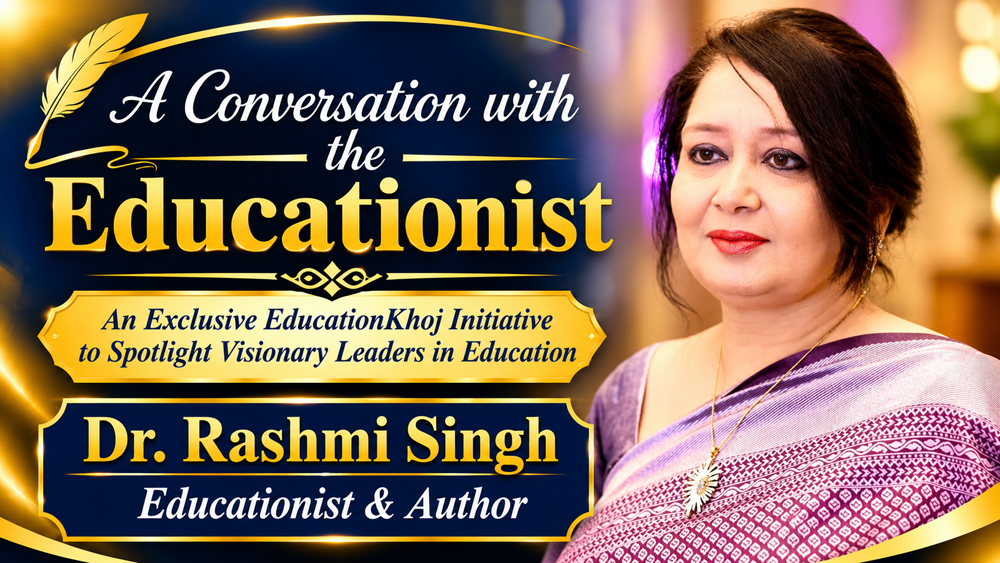
“A Conversation with the Educationist” is an exclusive EducationKhoj initiative that brings us closer to the visionaries shaping the future of education. Through insightful conversations, we explore their journeys, perspectives, leadership, and vision for educational excellence. In this edition, we feature Dr. Rashmi Singh, Educationist & Author
1. Please share your educational and professional journey.
Married right after graduation, my journey as an educator began unexpectedly while travelling across India with my Indian Telecom Service (ITS) husband—from pre-primary classes in Gorakhpur and Hazaribagh to teaching PGT English at Moradabad’s prestigious St. Mary’s, KCM and then started also as a Freelance Educator at Hisar. . Undeterred by frequent postings, I raised my children successfully while building a thriving coaching institute and earning an MBA, B.Ed., dual Master’s degrees, and a Ph.D. in English Literature.
Grounded by my formative years as an alumna of Loreto Convent, Ranchi; Notre Dame, Patna; and Patna Women’s College (Mt. Carmel College), my administrative chapter blossomed across Moradabad, Palwal, and Faridabad. Beyond serving as Vice Principal, Headmistress, and Founder CBSE Principal in Faridabad, I also stepped up to serve as Principal at another Faridabad school through the unprecedented challenges of the COVID-19 pandemic. My plate remained full as I expanded my horizons—serving for two years as Senior Officer, Brand Enhancement Strategy at Manav Rachna Educational Institutions, Aravali Hills, while nurturing my passion as an author of eight published books spanning parenting, self-help, historical fiction, and metro reads. Today, serving diligently as School Administrator in a top school of Faridabad, my journey stands as proof that rigorous hard work, strong writing skills, and undeterred hope can turn constant change into a proud, purposeful legacy.
2. You had the opportunity to establish and lead a school as its Founder Principal. What were the initial challenges, and how did you transform your vision into a successful educational institution?
Stepping into a newly founded institution in November 2016—just months after its inception in April—was an immense responsibility, especially as a first-time Principal. From day one, the challenges were high-stakes: securing CBSE affiliation for Grades X and XII from the ground up, calming anxious parents after the school separated from its parent institution, curbing student withdrawals, and driving fresh admissions.
Rather than letting the pressure of a debut leadership role hold me back, I embraced every hurdle as a learning curve and a call to action. (On a lighter note: I often laughed and compared myself to the Actor Devanand of the movie Guide).
With steady resolve and the dedicated support of my team, I single-handedly steered the demanding documentation, compliance, and readiness processes to secure CBSE affiliation for both secondary and senior secondary levels. At the same time, I worked to stem withdrawals and attract new families by strengthening academic rigour, maintaining transparent communication, and ensuring genuine care for every child’s growth. Seeing hesitant parents become deeply content—and watching admissions rise alongside lasting trust—proved that when grit meets teamwork and purpose, even a daunting first chapter can blossom into a thriving, respected institution.
3. As an educationist and administrator, what according to you are the most important qualities required to lead a school effectively and create a positive academic environment?
Having navigated everything from bustling pre-primary classrooms to building a CBSE school from scratch and steering campuses through the pandemic, I have learned that running a school effectively takes a blend of strength and heart. Above all, it demands grit and determination to stay steady through every hurdle, alongside compassion and motivation that turn an institution into a caring community. Equally vital is understanding your team—listening to your teachers, adapting swiftly to frequent curriculum changes, and training them continuously so they feel confident in the classroom. Above all else, knowing every child and their personal history is a must; when we understand a student's background and challenges, we can guide them with genuine empathy, creating a positive academic environment where every learner thrives.
4. Establishing a school from its foundation requires dedication, planning and leadership. What principles and values did you consider most important while building the institution?
While building the school from its foundation, my core principles were integrity, discipline, and lifelong learning—values shaped by my convent education at Loreto Convent, Notre Dame, and Patna Women’s College, and strengthened through earning my MBA in HR, B.Ed., dual Master’s degrees, and Ph.D. alongside raising my children. Combining administrative strategy with literary empathy, I believed in burning the midnight oil alongside my staff—leading from the front through meticulous planning, firm yet compassionate discipline, continuous teacher training, and knowing every child’s personal journey. By fostering genuine team spirit, shared accountability, and transparent communication with anxious parents, we turned collective hard work into lasting trust and academic excellence.
5. The Indian education system has witnessed significant changes over the years. How do you see the transformation of school education, particularly in terms of teaching methodologies, technology and student development?
The Indian school education system has undergone a welcome transformation—moving away from rote memorization toward competency-based learning, experiential methodologies, and smart digital integration. Today, technology makes concepts visual and accessible, while holistic frameworks focus on building critical thinking, communication, and emotional resilience alongside academics.
Equally transformative is the growing emphasis on active parent collaboration and structured student counselling, ensuring that emotional well-being and home-school alignment go hand in hand with academic progress.
However, from an administrator’s perspective, stability and predictability are just as vital as innovation. Introducing sudden policy or pattern changes just two to three months before board examinations creates unnecessary anxiety for students, parents, and teachers alike. A board examination should never feel like a last-minute sprint; students need at least a two-year runway—supported by steady guidance, counselling, and parental partnership—to absorb concepts gradually, build confidence bit by bit, and approach their exams with clarity and composure.
6. Today, academic performance is often measured through marks, grades and board examination results. Do you think schools are giving enough importance to creativity, critical thinking, life skills and holistic development?
While many schools talk about holistic growth, marks and board results still dominate the spotlight, leaving creativity, critical thinking, and life skills unevenly nurtured—often sidelined once senior classes begin.
True education must prepare students for the larger stage of life, equipping them with the confidence, articulation, and presence of mind needed for real-world challenges like interviews, group discussions, and leadership roles. Having mentored students across stages—and coached them in personality development and spoken English—I strongly believe schools must treat life skills, critical thinking, and creativity as core pillars rather than afterthoughts, shaping well-rounded individuals ready to thrive far beyond a report card.
7. What role do teachers play in shaping the future of students? How can school administrators motivate, empower and retain quality teachers?
Teachers are the true architects of a student’s future—for young minds, their teachers are always right, and children naturally look up to them as lifelong role models. I still carry the imprint of my own convent teachers, who polished my diction and pronunciation, shaped me into an excellent orator, and mentored me through umpteenth competitions to win best debater titles—all while being firm disciplinarians yet true friends and counsellors with whom we felt completely free to share our problems. That rare balance of clear boundaries and genuine warmth builds confidence and character that last a lifetime. To motivate, empower, and retain such quality educators, administrators must treat them as valued partners by investing in continuous training, granting classroom autonomy, recognizing their craft, and standing beside them so they feel inspired to stay and shape generations.
8. What are the major challenges faced by school administrators today, particularly in balancing academic excellence, financial sustainability, parental expectations and institutional growth?
Today’s school administrators walk a tightrope—balancing rising operational costs and regulatory demands against keeping fees affordable without ever compromising classroom quality. At the same time, parental expectations have shifted toward instant results and hyper-visibility, requiring leaders to educate families on holistic, steady growth rather than short-term exam pressure. Having navigated everything from building CBSE compliance from the ground up to leading through crisis, I believe the key to sustainable institutional growth lies in transparent financial planning, investing in teacher retention, and treating parents as partners so academic integrity always stays at the centre.
9. With the growing influence of Artificial Intelligence, smart classrooms and digital learning platforms, how do you think technology will reshape the role of teachers and the future of school education?
AI and digital platforms will streamline routine tasks and personalize learning pace, but they can never replace the human warmth, moral compass, and emotional mentorship of a real teacher. As technology evolves, the educator’s role shifts from mere information provider to guide, counsellor, and character builder, ensuring screens serve human potential rather than overshadowing it.
We are seeing rising cases of depression in schools and its repercussions. I feel this aspect have to be completely handled by the human mentors.
10. Looking back at your professional journey, which achievements, initiatives or milestones give you the greatest satisfaction and why?
Looking back, my greatest satisfaction lies in milestones that built character, discipline, and creative courage—from my formative years serving as Student Council President in Grade 7A, sweeping all three school honours in academics, perfect attendance, and Best Class Citizen for three consecutive years, winning in painting from Grade 1 alongside elocution and best debater titles, bagging best performer in Ramakrishna Paramahansa Society charity theatre, and winning second prize at IIT BHU in college. Carrying those values into school leadership, being honoured with the Best District Principal Award by the Science Olympiad Foundation (SOF) alongside multiple Best Principal recognitions—while building institutions, mentoring students, and authoring books—feels deeply fulfilling, and I owe every bit of that journey to my teachers, whose faith and guidance shaped who I am today.
11. What major reforms or changes would you like to see in the Indian school education system to make it more inclusive, skill-oriented, innovative and future-ready?
To make Indian school education truly inclusive, skill-oriented, and future-ready, we must shift decisively from high-stakes rote testing toward early vocational exposure, critical thinking, and real-world communication skills embedded from pre primary school onward. Equally vital is stronger psychological counselling, inclusive support for diverse learners, and continuous teacher upskilling, backed by policy stability so changes are phased in thoughtfully rather than rushed before exams. When every child’s unique strengths are nurtured alongside ethical values and adaptability, schools prepare confident human beings ready for any future.
12. What advice would you like to give to young educationists, aspiring school principals and educational administrators who wish to make a meaningful contribution to society through education?
To young educationists and aspiring principals, my advice is simple: uphold strong academics and firm discipline, yet be a child with children—without ever becoming over-friendly or crossing that clear border. Step onto the field to participate in their games, join classroom debates, and share picnics with them, while maintaining unmistakable boundaries so they remain in awe of you rather than taking you for granted. When students experience your genuine warmth while knowing exactly where the line stands, true reverence thrives—and you build schools that shape grounded, principled human beings.